- Home
- Media Kit
- MediaJet
- Current Issue
- Past Issues
- Reprints (PDF)
- Photo Specifications (PDF)
- Contact Us
- PRIVACY POLICY
- TERMS OF USE
Loading

ONLINE

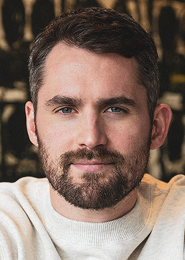
Kevin Love
Moving From Awareness To Action
Editors’ Note
Over more than a decade, Kevin Love has taken the National Basketball Association by storm. A unique superstar, Love’s career has been highlighted by five NBA All-Star elections, an NBA Championship in 2016, an Olympic gold medal in 2012, and a FIBA World Championship in 2010. He has also become an undeniable force beyond sports as he helps normalize the conversation surrounding mental health and creates an opportunity for others to do the same. After documenting his experience with depression and anxiety in a powerful personal essay in The Players’ Tribune, Love quickly evolved into the public spokesperson for mental health awareness among athletes. Continuing his advocacy in this space, he founded the Kevin Love Fund (KLF) in 2018, a fund dedicated to inspiring people to live their healthiest lives while providing the tools to achieve physical and emotional well-being. Since then, Love has been awarded the ESPY Arthur Ashe Courage Award, Change Maker Award by the Child Mind Institute, the NBA Cares Assist Award, and was an ESPY Muhammad Ali Sports Humanitarian Award finalist, all due to his work in mental health awareness.
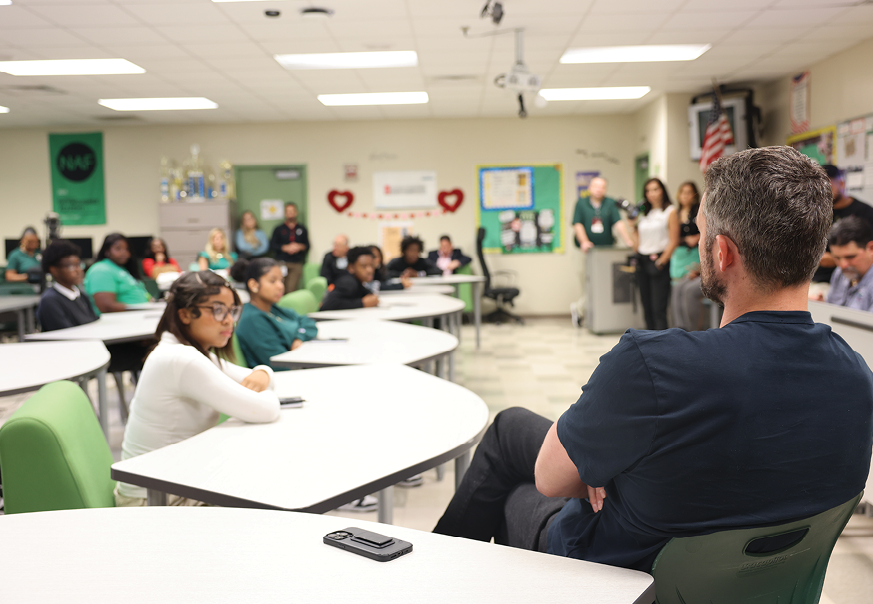
Kevin Love speaks with high school students in Miami, Florida,
during Mental Health Awareness Month, sharing his own
journey and encouraging open conversations about
mental well-being
What have been the keys to your longevity in the NBA?
Honestly, it has been about being willing to change, both physically and mentally. As I have gotten older, I have had to be really intentional with how I train. I have focused more on recovery, nutrition, flexibility, and sleep in a way I definitely did not think about when I was 20. I have also had to accept different roles and figure out how to make a team better beyond just what shows up in the box score. Sometimes that means leadership in the locker room, sometimes it is communication on the floor, and sometimes it is just showing younger guys what it looks like to be a pro every day.
Taking care of my mind has been just as important as taking care of my body. Therapy, meditation, and a lot of the tools we talk about through the Kevin Love Fund are things I use myself. Having a strong support system, staying curious, and being willing to reinvent myself again and again – that is what has kept me going and still loving the game.
When you reflect on your career, what are you most proud of?
The championship in Cleveland will always be a defining moment, especially doing it with that city and those teammates. But as I get older, what I’m most proud of is how I’ve grown as a person through the game. Speaking openly about mental health, starting the Kevin Love Fund, and seeing young people use our curriculum in classrooms and gyms around the world means as much to me as any accolade. Basketball gave me a platform, but it also gave me perspective. I’m proud that I didn’t just stay in the safe lane and that I chose to be vulnerable, to talk about panic attacks and anxiety, and hopefully make it easier for the next generation to ask for help.
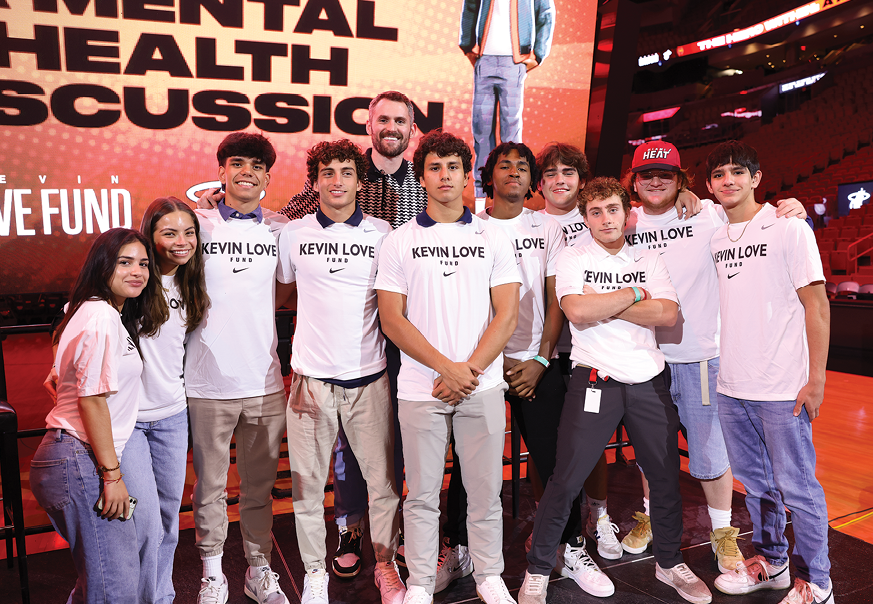
At Miami’s Kaseya Center, Kevin Love joins students for a
panel discussion and screening of the short film
The Spider Within: A Spider-Verse Story, exploring anxiety,
vulnerability, and the power of storytelling
What inspired you to open up publicly about your mental health struggles?
In 2017, after I had a very public panic attack during a game, I realized how much of my life had been about hiding anything that looked like weakness. Growing up in sports, you’re taught to “tough it out.” But that mindset was hurting me. I saw other players, like DeMar DeRozan, open up and it sparked something. I kept thinking, “If I’m feeling this alone, how many other people are too?” Hitting send on the “Everyone Is Going Through Something” article was terrifying, but it changed my life. The flood of messages afterward showed me that we badly needed a different conversation around mental health. That experience became the foundation for the Kevin Love Fund and our mission to help people, especially young people, understand that asking for help is a strength.
What was your vision for creating the Kevin Love Fund?
The simple version is this: I wanted to turn my hardest moments into something useful for other people. After going public with my own struggles, I didn’t want it to be a one-time article or a talking point. The vision for the Kevin Love Fund was to help people live authentic, emotionally healthy lives, with a big focus on young people who are still forming their identity. We built the Fund around three pillars: education, research, and changing the narrative. That means giving schools and teams concrete tools, supporting science that moves the field forward, and using storytelling to normalize conversations around mental health. At its core, the vision is to make it easier for the next generation to say, “I need help,” and actually have somewhere to turn.
Will you highlight the work and programs of the Kevin Love Fund?
Our work starts where young people already are, whether that be in classrooms, locker rooms, or online. Through our free mental health curriculum, we help students and educators build emotional literacy, empathy, and real coping tools they can use in everyday life. And this past year, we launched a program specific to student-athletes where we work with them to share their stories of struggle and resilience, showing kids that even their heroes have tough days. We also partner with leading universities and experts to support research on mental health interventions that actually work in schools and communities. And then there’s our narrative work – collaborating with brands, teams, and media to tell more honest stories about mental health. Every program is designed to move from awareness to action, so people aren’t just inspired, they’re equipped with the right tools.
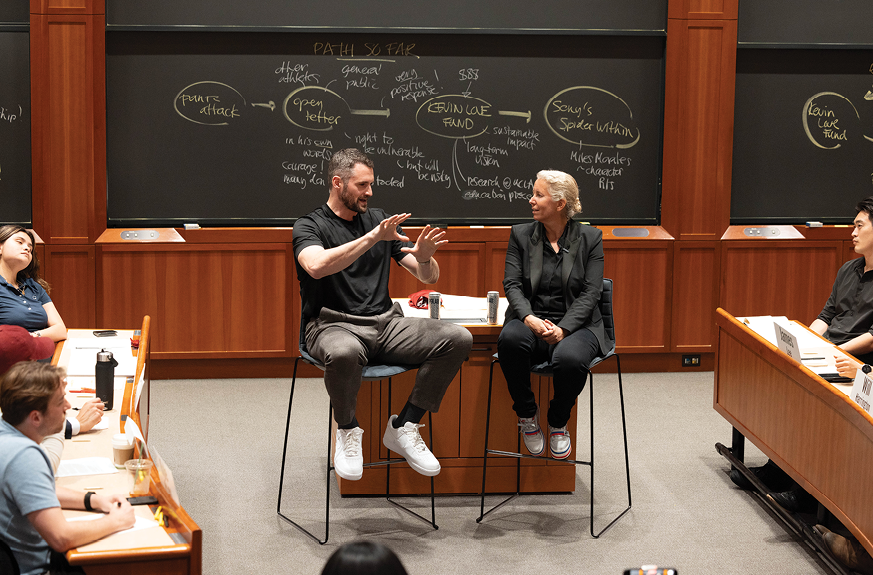
Harvard Business School Professor Anita Elberse
presents a case study on the Kevin Love Fund
as Kevin Love joins her in class to discuss the intersection
of sports, philanthropy, and mental health
How valuable has it been to build strong partners for the Kevin Love Fund?
It has been huge. We know the need is way bigger than one player or one foundation, so partners really help us meet people where they are. When we work with school districts and educators, we can take these big ideas about mental health and turn them into real lesson plans that kids and teachers actually use in the classroom.
Then you add in partners in research who help make sure what we are doing is backed by science and not just good intentions. And on the culture side, something like our partnership with Sony really showed me what is possible. We were able to bring mental health into a Spider-Verse short film, into a world and characters that kids already love. That is where it starts to cross over into pop culture and culturally relevant moments, and it helps make mental health a normal, everyday conversation instead of a taboo topic.
What advice would you give to young athletes dealing with pressure and expectations?
First, know that feeling pressure doesn’t mean something is wrong with you; it usually means you care. But you don’t have to carry it alone. My advice is to build your “team behind the team” – a coach you trust, a friend you can be real with, maybe a therapist or counselor if you have access. Talk about what you’re feeling before it boils over. Also, separate your identity from your performance. You are more than your stats, your ranking, or your last game. That’s something we emphasize in our Kevin Love Fund programs. We want young people to build a sense of self that isn’t completely tied to outcomes. Take care of your sleep, your body, and your mind with the same seriousness you give to training. That balance is what keeps you in the game long-term.
With all that you have accomplished in your career, are you able to take moments to reflect on your achievements?
It hasn’t always come naturally to me. I’m wired to think about what’s next, whether it’s the next season, the next project, the next challenge. But as I’ve gotten older, I’ve made more space for reflection and gratitude. Sometimes that looks like walking into an arena and really taking in the moment, or looking at old photos from my time in the NBA and remembering what my teammates and I have built together. Other times it’s reading a letter from a student who went through one of our Kevin Love Fund programs and says it helped them ask for help. Those moments make me pause. The wins, the All-Star appearances – I’m incredibly proud of them. But being able to look back and see both a basketball legacy and a growing impact off the court is what truly grounds me.