- Home
- Media Kit
- MediaJet
- Current Issue
- Past Issues
- Reprints (PDF)
- Photo Specifications (PDF)
- Contact Us
- PRIVACY POLICY
- TERMS OF USE
Loading

ONLINE

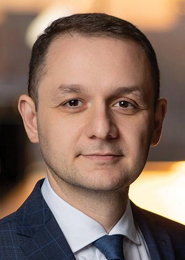
Alexandru Chirita
The Responsibility
Of Power
Editors’ Note
Alexandru Chirita is a professional with substantial experience in the legal and energy fields. After earning his bachelor’s degree from the Faculty of Law at the University of Bucharest in 2008, Chirita subsequently dedicated nearly a decade to practicing law. Throughout his career, he has amassed comprehensive expertise in consultancy on various legal matters, encompassing corporate law, commercial transactions, and litigation. His profound understanding of legal frameworks, coupled with his aptitude for devising and executing effective legal strategies, has been instrumental in achieving organizational objectives. As an active member of the professional community, Chirita participates in several organizations, including the International Association of Privacy Professionals, the European Law Institute, the United Nations Association of Romania, and the Romanian Arbitration Institute. Before joining Electrica, he held the positions of Legal Manager and Data Protection Manager at Hidroelectrica. In these capacities, he formulated and executed legal and data protection strategies, ensuring compliance with regulatory mandates, managing litigation and disputes, and supervising contract negotiations. His legal acumen and experience have proven invaluable in his role as CEO of Electrica, a position he has held since May 2022. Chirita holds a bachelor’s degree in law from the Faculty of Law at the University of Bucharest, a master’s degree in law and European governance from the National School of Political and Administrative Studies (SNSPA), a master’s degree in European Union Law, and is currently pursuing a doctorate in administrative sciences at SNSPA.
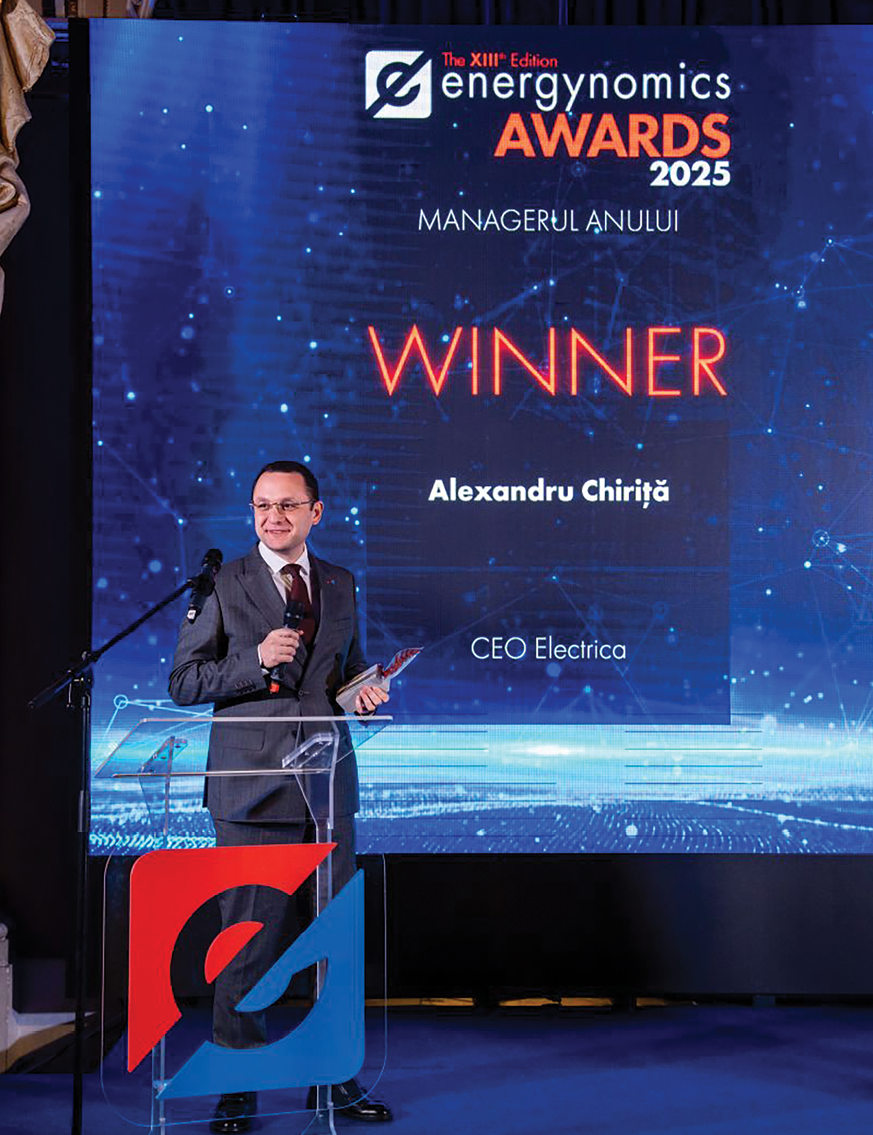
Alexandru Chirita, Chief Executive Officer of Electrica,
receiving the 2025 Manager of the Year
Energynomics Award
Electrica operates critical energy infrastructure in a NATO frontline state. Will you describe your company’s strategic significance?
Electrica is one of the cornerstone companies of Romania’s energy sector and a critical infrastructure operator within the NATO alliance. We manage 40.8 percent of Romania’s national electricity distribution network, spanning 205,000 kilometers, making us the country’s largest grid operator, serving 4 million customers across 18 counties with a team of 8,000 professionals. Since July 2014, we have been listed on the Bucharest and London stock exchanges, with a majority private capital. We are the only Romanian listed company with integrated operations in electricity distribution, supply, and production.
Our strategic significance extends beyond commercial metrics. Romania sits at a critical juncture in European energy security. We share a border with Ukraine and the Black Sea, making grid resilience not merely a business priority, but a matter of allied security. Every investment we make in network hardening, redundancy, and cybersecurity strengthens the broader NATO energy architecture.
What differentiates Electrica is our long-term perspective and financial discipline. We operate in a regulated environment, but we see regulation as a framework that allows us to invest strategically, modernize infrastructure responsibly, and create durable value. Our presence on both the Bucharest and London stock exchanges reinforces this discipline. We are accountable to international capital markets and hold ourselves to the highest governance standards.
Your financial performance has been exceptional. What has driven Electrica’s results?
In the past years, Electrica has achieved record financial performance, including profit growth exceeding 400 percent. The company’s market valuation has reached approximately €1.6 billion, reflecting strong confidence from capital markets. We completed Romania’s largest corporate, non-financial, green bond issuance at 500 million euros, demonstrating that sustainable infrastructure investment and strong returns are complementary objectives. Shareholders also approved a financing ceiling of up to €1 billion to support our growth and expansion strategy.
The key factors are focus and discipline. Distribution remains our backbone, and we have prioritized investments that improve network reliability, reduce technical losses, and increase resilience to extreme weather events and security threats. At the same time, we have expanded strategically into renewable generation and energy storage. We are developing 1 GWh of battery storage capacity and targeting 1,000 MW of renewable generation by 2030. In parallel, we are also looking at gas power plant expansion of up to 400 MW as part of a balanced and resilient energy mix.
Moreover, a key element is our partnership with Esyasoft, part of an Emirati group within International Holding Company (IHC). Together, we are developing a battery and smart meter manufacturing facility, a project that strengthens the local value chain and enhances the region’s technological autonomy.
Strong governance and transparency are non-negotiable in today’s environment. They are essential for maintaining the trust of investors, regulators, and strategic partners. Our track record has enabled us to raise the financing needed for ambitious infrastructure modernization.
Energy transition is often discussed abstractly. What does it mean concretely for Electrica and for European energy security?
For us, the energy transition is not an abstract concept. It is a series of concrete projects, investments, and operational decisions that directly affect European energy independence. It means upgrading aging infrastructure, deploying smart grid technologies, integrating distributed renewable generation, and preparing networks for bidirectional energy flows.
The broader context matters enormously. Europe has learned painful lessons about energy dependence. Romania has a diversified energy mix (nuclear, hydro, wind, solar, and domestic gas) that positions us as a potential regional energy hub. Electrica’s grid modernization is essential infrastructure for realizing that potential and reducing Europe’s vulnerability to external pressure.
We are also focused on fairness. Affordability is critical, particularly in Central and Eastern Europe where energy costs directly affect household welfare and industrial competitiveness. Our responsibility is to balance environmental objectives with economic realities – a transition that leaves communities behind is not sustainable.
How is Electrica approaching digitalization and emerging technologies like artificial intelligence?
Innovation in a regulated utility environment must be purposeful. It is about solving real operational and security challenges, not experimentation for its own sake. We are implementing advanced monitoring systems, automation, and predictive maintenance tools powered by artificial intelligence that allow us to detect issues before they become disruptions. AI applications in our operations include network optimization, demand forecasting, and enhanced customer interaction. We are deploying smart metering at scale, a prerequisite for dynamic pricing, demand response, and prosumer integration. Every technology investment is evaluated through a cybersecurity lens. Critical infrastructure protection is foundational, not an afterthought. And, as I mentioned earlier this year on stage at Google Cloud Day, we are also ready to support hyperscale data center expansion in Romania.
We actively seek technology partnerships with leading firms, particularly those with proven capabilities in grid modernization, energy storage integration, and critical infrastructure cybersecurity. The transformation ahead requires collaboration between utilities, technology providers, and governments.
You transitioned from a legal career to leading one of Romania’s largest energy companies. How has that shaped your leadership?
My background in law, founding a firm and developing legal technology platforms, gave me experience navigating complex regulatory environments and building organizations from the ground up. Energy infrastructure operates within intricate legal, regulatory, and political frameworks, and that perspective has been valuable. But leadership in this sector has reinforced something more fundamental: humility and teamwork matter more than having all the answers. Some of the most important insights come from those closest to operations. My role is to ask the right questions, listen carefully, create an environment where diverse perspectives are valued, and then make deliberate decisions.
I believe in servant leadership – leaders exist to serve customers, employees, and communities. When that purpose stays central, performance follows naturally. Infrastructure choices we make today will shape the energy system for decades. That responsibility demands caution, discipline, and consistency between words and actions.
How do you see Romania’s role in the broader regional energy landscape?
Romania has significant potential to serve as a regional energy hub within the European and transatlantic architecture. We have technical expertise built over decades, a diversified generation mix, substantial domestic resources, and strategic geography connecting Central Europe to the Black Sea region. Grid development will be decisive. Without strong, resilient networks, the energy transition cannot succeed, and energy security remains vulnerable. This requires close cooperation between utilities, regulators, policymakers, and increasingly, between allied nations. Access to long-term financing and technology partnerships with leading global firms will determine how quickly we can modernize.
I am optimistic. The strategic direction is clear, European and transatlantic commitment provides a strong framework, and Romania is ready to be a reliable partner. Success will depend on execution, discipline, and collaboration across borders. Recently, for example, Electrica’s Board of Directors approved the direct consolidation of our operations in the Republic of Moldova under the parent company. It is a concrete step toward building a regional energy hub, and we have more plans to expand in the region and the EU. This is the foundation, not the destination. Romania has spoken for a long time about its regional role. It is time to build.
What message would you offer to international partners considering engagement with Romania’s energy sector?
Romania offers a compelling combination: a stable, NATO-allied democracy with strong rule of law, a growing economy, substantial infrastructure investment needs, and a workforce with deep technical capabilities. We are not a speculative frontier market. We are a European Union member state with transparent regulatory frameworks and access to European financing mechanisms. For technology providers, project developers, and strategic investors, Romania represents an opportunity to participate in one of Europe’s most significant infrastructure modernization programs. Electrica, as the largest grid operator, is positioned at the center of this transformation.
We welcome partners who share our long-term perspective. Those interested in building durable value rather than short-term extraction. The work ahead is substantial, the stakes are high, and the right partnerships will make a meaningful difference for European energy security.